General IT and compliance

We are proud to support over 300 care services and multiple head office locations among our core clients
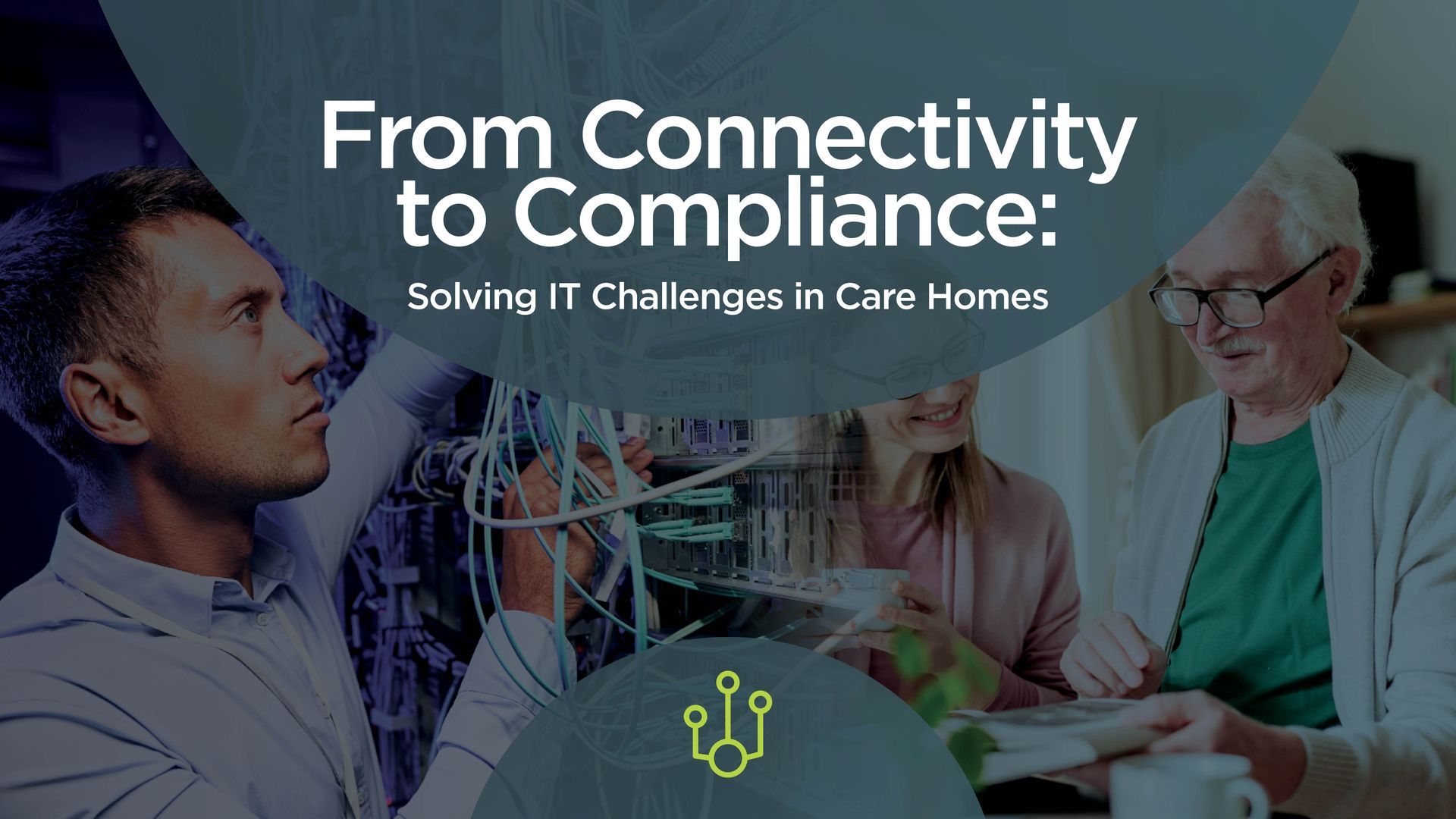
We understand that running a care home is demanding, and having the right technology is essential. Many of our care provider customers have faced similar challenges in the past but with the right solutions they have transformed the way they operate.

Do you experience any of the following issues? If so, we can help overcome them with effective solutions.


1. Poor Connectivity and Communication Issues


Problem:

Weak or inconsistent Wi-Fi signals cause frustration for both staff and residents, caused by slow internet speeds. This can lead to delays in accessing online care systems and poor mobile phone signals in bedrooms making it difficult for residents to receive calls.

No family wants to struggle to connect with loved ones via phone or video calls and worse still, no phone coverage in certain areas means staff or residents may be unable to make 999 emergency calls.


Solution:

We eliminate Wi-Fi dead zones by installing strong, high-speed internet throughout your care home. We improve mobile phone coverage, ensuring clear communication for residents and staff. We enhance phone and video call capabilities (e.g., FaceTime, Zoom) so families can stay connected. Our reliable IT systems ensure that staff can quickly respond to urgent situations.


2. Unreliable IT Systems Causing Disruptions


Problem:

Slow, outdated computers and poor internet connections make everyday tasks frustrating. Care plan devices frequently disconnect, making it harder for staff to document care efficiently or worse still, essential care software and cloud applications aren’t working properly, leading to delays and inefficiencies.


Solution: 

We upgrade outdated IT systems and enhance internet connections to ensure quick access to vital information. Our reliable IT infrastructure ensures the smooth operation of essential care applications.


3. Cybersecurity Risks


Problem:

Care homes are vulnerable to cyberattacks, including ransomware targeting NHS and social care services. Sensitive resident data needs stronger protection to prevent breaches and maintain trust.


Solution:

We implement advanced cybersecurity solutions to protect resident data from cyber threats. Our security measures ensure compliance with data protection regulations and reduce the risk of breaches. Staff training on cybersecurity awareness helps prevent phishing attacks and social engineering threats.


We provide real-time threat monitoring and alerts to keep your systems secure and design comprehensive backup and disaster recovery plans, incorporating cloud, on-premise, and hybrid solutions.


4. Lack of Integration with Digital Health Records


Problem:

Many care homes still use paper records, making it difficult to share critical information with hospitals and GPs. The lack of proper digital systems affects care coordination, leading to delays in treatment.


Solution:

We support and partner with care homes adopting digital social care records that integrate with NHS and GP systems. Our solutions enable secure, real-time sharing of resident information, improving care coordination and decision-making.

5. Challenges in Adopting New Technology


Problem:

AI and smart monitoring could improve care, but staff worry about losing the human touch. All new technology must be easy to use and enhance, rather than replace, personal care.


Solution:

We collaborate with partners that can introduce AI and smart monitoring tools that support staff rather than replace human interaction. Our approach ensures technology complements compassionate caregiving while improving efficiency and safety. 


6. Poor IT Infrastructure & Maintenance Issues


Problem:

Messy, tangled cabling creates safety hazards and makes maintenance difficult. Unreliable IT systems can make regulatory compliance with the Care Quality Commission (CQC) challenging with failed IT systems impacting safety ratings, affecting trust and reputation.


Solution:

We organise and maintain IT infrastructure, ensuring safe, efficient network systems. We can provide a holistic view of IT service levels, giving IT directors and on-site support teams access to real-time insights.

Our services help care homes stay compliant with CQC and maintain strong safety ratings. Using proactive monitoring tools, we detect and resolve IT issues before they become major problems. Our dedicated service desk answers queries, resolves issues, and provides technical support—with 95% of issues fixed remotely. 


We facilitate cloud adoption, allowing access to secure applications from any location with an internet connection, boosting collaboration, productivity, and cost efficiency.


Helping Care Homes Run Smoothly


We understand that these challenges add extra pressure to an already demanding job. With the right technology in place, care homes can improve efficiency, security, and care quality—making life easier for both staff and residents.


How We Can Support You Further


  • FREE IT Audit – Let us assess your current systems and recommend improvements. 
  • Book a FREE Online Meeting – Discuss your specific needs with our experts.
  • Training & Support – We offer training to help your staff make the most of new technology.

Let’s work together to build a reliable, secure, and well-connected care environment
December 2, 2025
AI tools are everywhere at the moment, but for most small businesses the real question is simple: can this actually help us day to day? The answer, increasingly, is yes. AI agents are becoming a practical, affordable way for UK SMBs to lighten workloads, improve responsiveness and strengthen their cyber security without adding to headcount. Here’s what they can realistically take off your plate. Take the admin you never get time for Most small teams lose hours each week to tasks like updating spreadsheets, booking meetings, chasing invoices or sorting inbox clutter. An AI agent can handle these automatically in the background — consistently, accurately and without needing to be chased. It’s not about replacing people; it’s about giving them space to focus on the work that actually moves the business forward. Improve customer response times Customers expect fast answers, even when your team is busy or out on site. AI agents can deal with routine enquiries, provide updates, and pass more complex queries straight to the right person. You stay responsive, your team stays sane, and nothing gets forgotten in the rush. Add another layer of cyber protection Cyber threats are rising across the UK, and many of the attacks we’re seeing at Cranborne start with human error — a missed warning sign, a convincing phishing email, or an unusual login that doesn’t get spotted in time. An AI agent can monitor activity in the background and raise a flag the moment something looks suspicious. It’s not a silver bullet, but it’s an extra pair of eyes when you need it most. Support sales and marketing without extra staff From following up with leads to drafting emails and analysing which campaigns actually worked, AI agents help small businesses stay consistent. They don’t replace your voice or your expertise — they simply keep the wheels turning so opportunities don’t slip through the cracks. Help you make better decisions, faster Instead of digging through systems for data, an AI agent can pull together quick reports, highlight trends and spot issues early. That means business owners get clearer visibility without spending evenings trawling through spreadsheets. The takeaway AI agents aren’t a gimmick. Used well, they become part of the team — handling the repetitive, the routine and the time-consuming. For UK SMBs under pressure to do more with less, they offer a straightforward way to improve efficiency, strengthen security and give your people their time back.
December 2, 2025
2026 will be a defining year for UK small and medium businesses. Technology is no longer just a background function – it shapes resilience, productivity, and competitiveness. At Cranborne Tech, we see this first-hand across care providers, financial services, retail, and non-profits. The organisations moving forward are the ones treating IT as a strategic enabler, not a cost centre. 1. Cybersecurity First: A Zero-Trust Reality Cyber threats continue to rise, and insurers now require demonstrable controls. SMBs must embed Zero Trust principles: MFA everywhere, continuous monitoring, dark web monitoring and phishing simulations as part of regular staff training. Security is now the foundation of every digital decision. 2. AI-Driven Productivity AI is now built into everyday tools like Microsoft 365. SMBs can save hours each week through automated reporting, meeting summaries, documentation support, and enhanced customer service workflows. Responsible governance and staff training must sit alongside adoption. 3. Cloud Cost Control Licensing and cloud waste became a major issue in 2024–2025. In 2026, SMBs should focus on rationalising tools, removing unused subscriptions, and right-sizing backup and cloud storage plans. A cleaner, more efficient cloud estate lowers costs and reduces complexity. 4. Modernising Infrastructure Cloud environments are now the default, although hybrid is still operational where needed. SMBs need reliable networks, standardised devices, secure remote access, and infrastructure capable of supporting AI-driven workloads. Modernisation boosts stability and improves user experience. 5. Business Continuity That Works Backups alone aren’t enough. SMBs need recoverability: encrypted cloud backups, offline copies, documented disaster recovery plans, and regular testing. Insurers and partners increasingly expect evidence, not assumptions. 6. Compliance and Governance Maturity Clear policies, documented patching, supplier assurance, and ongoing training form the baseline for regulated sectors. Mature governance builds trust and removes friction during audits or contract renewals. 7. Employee Experience Through IT Smooth onboarding, consistent devices, self-service capability, and proactive support make a measurable difference to productivity. In 2026, IT is a core part of employee experience. 8. Automating Everyday Workflows SMBs can now automate HR approvals, finance tasks, customer service routing, and reporting without enterprise budgets. Small steps create meaningful efficiency gains. Book a free IT audit The businesses that will thrive in 2026 are those treating IT as a growth partner. Cranborne Tech is here to help UK SMBs build resilient, secure, and future-ready digital foundations. If you want to understand how your IT supports your business goals and identify any gaps before they become risks, book a free IT audit . We’ll review your current setup and guide you on the next steps.