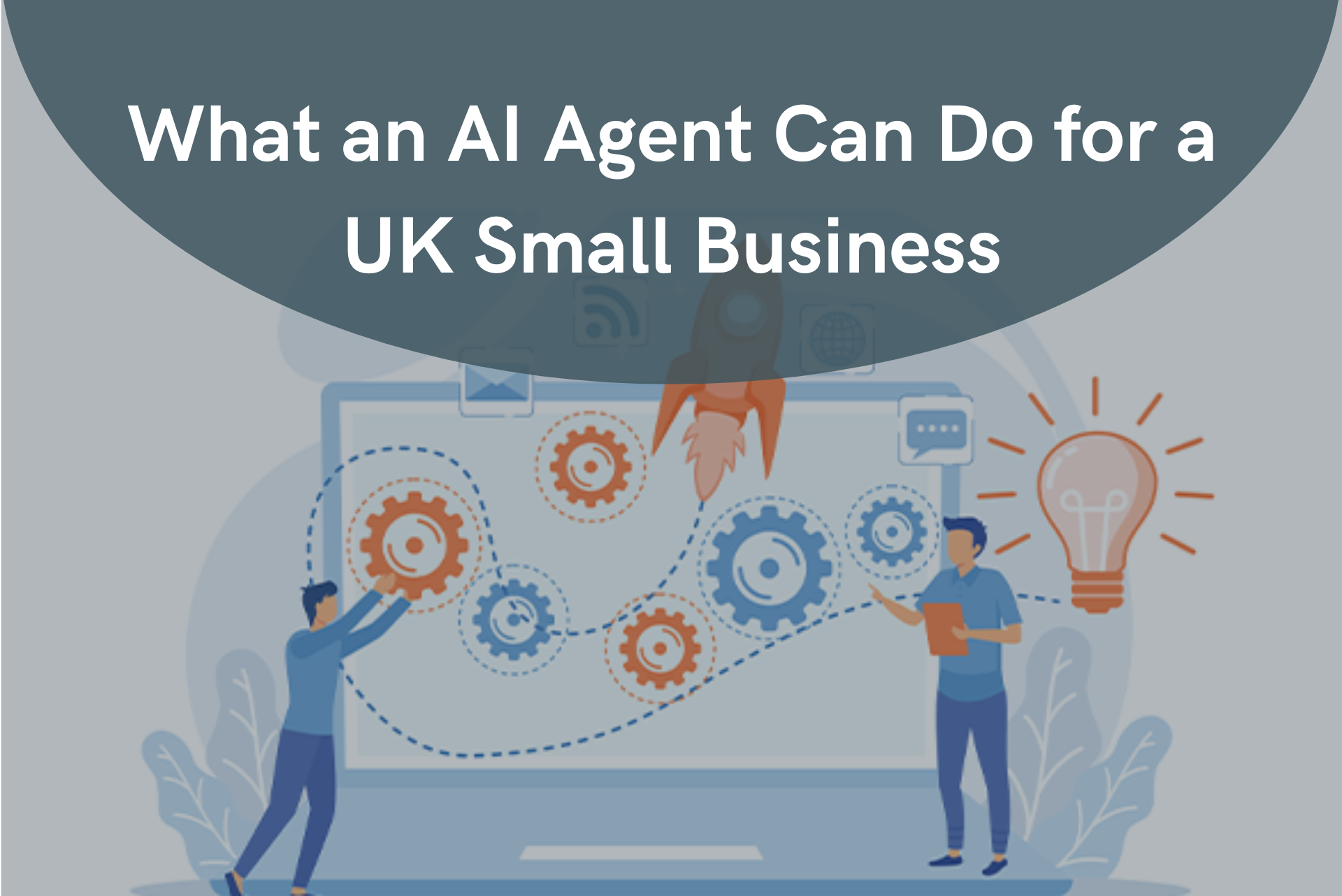
What an AI Agent Can Do for a UK Small Business
AI tools are everywhere at the moment, but for most small businesses the real question is simple: can this actually help us day to day? The answer, increasingly, is yes. AI agents are becoming a practical, affordable way for UK SMBs to lighten workloads, improve responsiveness and strengthen their cyber security without adding to headcount.


Here’s what they can realistically take off your plate.


Take the admin you never get time for


Most small teams lose hours each week to tasks like updating spreadsheets, booking meetings, chasing invoices or sorting inbox clutter. An AI agent can handle these automatically in the background — consistently, accurately and without needing to be chased. It’s not about replacing people; it’s about giving them space to focus on the work that actually moves the business forward.


Improve customer response times


Customers expect fast answers, even when your team is busy or out on site. AI agents can deal with routine enquiries, provide updates, and pass more complex queries straight to the right person. You stay responsive, your team stays sane, and nothing gets forgotten in the rush.


Add another layer of cyber protection


Cyber threats are rising across the UK, and many of the attacks we’re seeing at Cranborne start with human error — a missed warning sign, a convincing phishing email, or an unusual login that doesn’t get spotted in time.
An AI agent can monitor activity in the background and raise a flag the moment something looks suspicious. It’s not a silver bullet, but it’s an extra pair of eyes when you need it most.


Support sales and marketing without extra staff


From following up with leads to drafting emails and analysing which campaigns actually worked, AI agents help small businesses stay consistent. They don’t replace your voice or your expertise — they simply keep the wheels turning so opportunities don’t slip through the cracks.


Help you make better decisions, faster


Instead of digging through systems for data, an AI agent can pull together quick reports, highlight trends and spot issues early. That means business owners get clearer visibility without spending evenings trawling through spreadsheets.


The takeaway


AI agents aren’t a gimmick. Used well, they become part of the team — handling the repetitive, the routine and the time-consuming. For UK SMBs under pressure to do more with less, they offer a straightforward way to improve efficiency, strengthen security and give your people their time back.
December 2, 2025
2026 will be a defining year for UK small and medium businesses. Technology is no longer just a background function – it shapes resilience, productivity, and competitiveness. At Cranborne Tech, we see this first-hand across care providers, financial services, retail, and non-profits. The organisations moving forward are the ones treating IT as a strategic enabler, not a cost centre. 1. Cybersecurity First: A Zero-Trust Reality Cyber threats continue to rise, and insurers now require demonstrable controls. SMBs must embed Zero Trust principles: MFA everywhere, continuous monitoring, dark web monitoring and phishing simulations as part of regular staff training. Security is now the foundation of every digital decision. 2. AI-Driven Productivity AI is now built into everyday tools like Microsoft 365. SMBs can save hours each week through automated reporting, meeting summaries, documentation support, and enhanced customer service workflows. Responsible governance and staff training must sit alongside adoption. 3. Cloud Cost Control Licensing and cloud waste became a major issue in 2024–2025. In 2026, SMBs should focus on rationalising tools, removing unused subscriptions, and right-sizing backup and cloud storage plans. A cleaner, more efficient cloud estate lowers costs and reduces complexity. 4. Modernising Infrastructure Cloud environments are now the default, although hybrid is still operational where needed. SMBs need reliable networks, standardised devices, secure remote access, and infrastructure capable of supporting AI-driven workloads. Modernisation boosts stability and improves user experience. 5. Business Continuity That Works Backups alone aren’t enough. SMBs need recoverability: encrypted cloud backups, offline copies, documented disaster recovery plans, and regular testing. Insurers and partners increasingly expect evidence, not assumptions. 6. Compliance and Governance Maturity Clear policies, documented patching, supplier assurance, and ongoing training form the baseline for regulated sectors. Mature governance builds trust and removes friction during audits or contract renewals. 7. Employee Experience Through IT Smooth onboarding, consistent devices, self-service capability, and proactive support make a measurable difference to productivity. In 2026, IT is a core part of employee experience. 8. Automating Everyday Workflows SMBs can now automate HR approvals, finance tasks, customer service routing, and reporting without enterprise budgets. Small steps create meaningful efficiency gains. Book a free IT audit The businesses that will thrive in 2026 are those treating IT as a growth partner. Cranborne Tech is here to help UK SMBs build resilient, secure, and future-ready digital foundations. If you want to understand how your IT supports your business goals and identify any gaps before they become risks, book a free IT audit . We’ll review your current setup and guide you on the next steps.
December 2, 2025
Over recent months, we’ve seen a sharp rise in phishing activity across our client base — from care providers and financial services to retail and non-profits. Attacks are becoming more sophisticated, more targeted and, crucially, far more convincing. And it isn’t just us seeing the escalation. Darktrace’s global analyst team recently reported that Christmas-themed phishing attacks jumped 327% , while Black Friday and Cyber Monday–themed attacks surged 692% compared to early November — evidence of cybercriminals exploiting peak trading periods. (Full report: darktrace.com/blog/phishing-attacks-surge-in-buildup-to-black-friday) These findings reflect broader national trends. A 2025 UK survey found that 99.6% of retail IT security professionals experienced an increase in cyber threats, with phishing and help-desk impersonation scams among the most common. Frontline teams in particular are being targeted with emails crafted to appear urgent, routine or familiar. The report also identified supply chain exposure as a major vulnerability, with 46% viewing third-party suppliers as their greatest risk. (Source: KnowBe4 – UK Retail Sector Report)